Science Translation Project
In this project, we were challenged to take a science article that was nothing but science language, which was impossible to understand. Our job was to take our given article and translate it as if we were talking to middle school Parents trying to teach their kids to learn all about cells and how they carry out all their processes.
SUMMARY
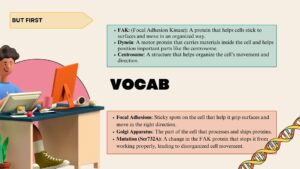
For better understanding the definitions of some words need to be set. Fibroblasts are a type of cell that move around to create connective tissue, aiding in the healing process. Focal adhesion kinase, shortened as FAK throughout this paper, is a protein that helps stick together the different facets within the fibroblast. Dynein is just a protein that has a reactionary property in the golgi apparatus, an organelle that processes proteins and acts as a brain or mover for all eukaryotic cells, but in this case, fibroblasts. Cells need to organize their internal structures in order to move efficiently and aid in the overall process of healing. This paper focuses on fibroblasts, a type of cell that moves by positioning its center and golgi apparatus in front of the nucleus. A key factor in the process of fibroblast migration is dynein, a protein that pulls the center of the fibroblasts forward using microtubules. Throughout this process FAK (focal Adhesion Kinase) , a protein, needs to be in function. FAK helps dynein attach to focal adhesions, anchoring it to the cell surface, providing movement. The paper finds that FAK interacts with dynein to help the migration of fibroblasts as the dynein sticks to the FAK during polarisation, or movement of the centrosome. The paper is presented to highlight the role of the FAK protein while using a proper model to make clear the role of the movement of the dynein protein. And also provides an adaptable method to understand the role the traction forces of the dynein protein in the golgi apparatus, that move the centrosome efficiently.
Q&A Study questions (EDIT)
-
What role does FAK play in nuclear positioning during cell migration?
Answer: FAK is essential for proper nuclear positioning by ensuring the nucleus moves rearward before Golgi polarization occurs. In FAK−/− cells, this movement is impaired, causing the nucleus to shift forward instead. This suggests that FAK regulates nuclear positioning independently of its interaction with dynein.
- What does the study reveal about the relationship between dynein, focal adhesions, and FAK?
Answer: Dynein spots were observed at focal adhesions in living cells but not in fixed fibroblasts, suggesting a transient interaction. This interaction was lost in FAK−/− cells, indicating that FAK helps regulate dynein’s association with focal adhesions during migration. - What method did scientists use to observe dynein localization in migrating cells?
Answer: Researchers used TIRF microscopy (Total Internal Reflection Fluorescence Microscopy) to visualize dynein localization at the leading edge of migrating fibroblasts.
- How does FAK regulate the interaction between dynein and dynactin?
Answer: FAK is required for dynactin (a dynein cofactor) to associate with focal adhesions at the leading edge. This interaction is crucial for proper cell polarization and directed movement.
- Why is FAK important in cancer research?
Answer: Since FAK helps regulate cell movement, it plays a role in cancer progression, where cells migrate abnormally and invade new tissues. Understanding FAK’s function could help develop cancer treatments targeting uncontrolled cell movement.
-
What happens to nuclear rotation in FAK-deficient cells?
Answer: The nucleus rotates as the cell migrates, helping guide movement. FAK-deficient cells show reduced nuclear rotation, which affects centrosome alignment but does not completely stop movement.
-
How do fibroblasts and astrocytes differ in their use of dynein?
Answer: In fibroblasts, dynein pulls the centrosome forward to guide migration. In astrocytes, dynein bends microtubules differently, suggesting that different cell types use dynein in distinct ways for movement.
-
How does FAK contribute to Golgi polarization?
Answer: FAK helps position the Golgi apparatus independently of nuclear rotation. Cells lacking FAK or carrying mutations like S732A-EGFP show significantly reduced ability to orient the Golgi correctly.
- What is the role of traction forces in cell migration?
Answer: Traction forces are exerted by cells on their substrate (the surface they move on). These forces, regulated by focal adhesions and dynein, help guide the centrosome and Golgi into position for efficient movement.
-
How does dynein contribute to cell migration?
Answer: Dynein is a motor protein that moves along microtubules and helps pull the centrosome toward the front of migrating cells. It also plays a role in organizing intracellular components and maintaining cell polarity.
We are presenting 2/19 (8 minutes)
Steps: paste your summaries in order, with your own notes. Afterwards we can ft and come up with the slides.
While reading keep in mind the following questions: “What would parents/ highschool students find interesting/useful? Why should they care? What do they need to know? What language is most accessible for them? What examples may make the material clearer?”
Plan E: Presenting to parents who have to help their high school students study for an AP exam. (like sticky note studying, Q&A, definitions)
Page grouping:
1-4: Jayvalyn
5-8: Nikyle
9-12: Christina
13-15:Tamerlan
16-18: Sadia
Summeries:
Jayvalyn:
- Fibroblasts are cells that move in a specific direction, and they position important structures (the centrosome and Golgi apparatus) in front of the nucleus.
- The movement and positioning of these structures depend on a motor protein called dynein.
- Dynein helps pull the centrosome toward the front of the cell using microtubules.
- It wasn’t clear how dynein acts at the front of migrating cells.
- Cell migration is an essential process where cells move in a specific direction, often seen in wound healing and development.
- Fibroblasts are a type of cell that helps form connective tissue and move by organizing their internal parts to face the direction of movement.
- The centrosome and Golgi apparatus (important cell structures) need to be positioned correctly for efficient movement.
- A protein called Focal Adhesion Kinase (FAK) interacts with dynein, a motor protein that helps move things inside the cell.
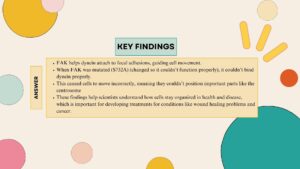
- FAK helps dynein attach to focal adhesions (points where the cell grips its surroundings), allowing for proper centrosome positioning.
- When FAK is missing or mutated, cells struggle to organize their centrosome and Golgi, leading to poor movement direction.
- FAK plays a crucial role in organizing cell structure and guiding cell movement.
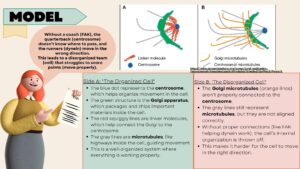
- A model is proposed where dynein, anchored by focal adhesions, helps pull the centrosome into position.
- This discovery may have implications for cancer therapy, as FAK is involved in cell structure changes during cancer progression.
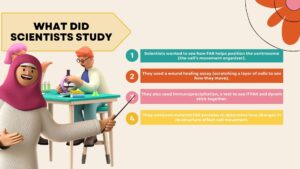
- Scientists looked at the positioning of the Golgi apparatus and centrosome in relation to the direction the cell was moving.
- They marked cell structures with fluorescent dyes to observe them under a microscope.
- They found that cells without FAK (FAK -/- cells) had trouble correctly positioning the Golgi and centrosome compared to normal cells.
- When they introduced a special version of FAK (called FAK S732A-EGFP) that couldn’t interact properly with other proteins, the cells still failed to fix the positioning issue.
Nikyle:
Pg5-8
The research article investigates the role of Focal Adhesion Kinase (FAK) and dynein in cell polarization and migration, particularly focusing on their interaction and how they influence the positioning of the centrosome and Golgi apparatus in migrating cells
- FAK and Dynein Interaction: FAK co-immunoprecipitates with dynein and paxillin, and this interaction is crucial for proper cell polarization. FAK is required for the enrichment of dynein at the leading edge of migrating cells.
- Dynein Localization: Dynein is enriched at the leading edge of wild-type (wt) fibroblasts, but this enrichment is lost in FAK-deficient (FAK−/−) cells. FAK also regulates the localization of other proteins like **APC** and **GKAP** at the leading edge.
- Centrosome and Golgi Positioning: FAK and dynein are involved in positioning the centrosome and Golgi apparatus in front of the nucleus during cell migration. FAK is required for the rearward movement of the nucleus, which is independent of dynein interaction.
- Dynactin and Focal Adhesions: Dynactin, a dynein cofactor, also localizes at the leading edge and co-localizes with focal adhesions. FAK regulates the transient association of dynactin with focal adhesions, which is crucial for cell polarization.
- Nuclear Positioning: FAK is necessary for the proper rearward positioning of the nucleus during cell migration, but this process is independent of dynein.
Definitions:
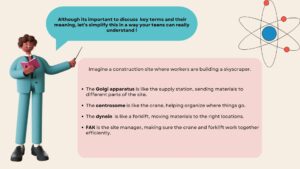
- Dynein: A motor protein that moves along microtubules and is involved in intracellular transport and cell division.
- FAK (Focal Adhesion Kinase : A protein involved in cell adhesion and migration, playing a key role in signaling at focal adhesions.
- Paxillin: A protein that localizes to focal adhesions and is involved in cell adhesion and signaling.
- Centrosome : An organelle that serves as the main microtubule-organizing center in animal cells and is involved in cell division and polarity.
- Golgi Apparatus :An organelle involved in modifying, sorting, and packaging proteins for secretion.
- APC (Adenomatous Polyposis Coli): A tumor suppressor protein involved in cell adhesion and microtubule stabilization.
- GKAP (Guanylate Kinase-Associated Protein): A protein that interacts with dynein and is involved in microtubule anchoring at the cell leading edge.
- Dynactin :A protein complex that works with dynein to facilitate intracellular transport along microtubules.
- TIRF Microscopy (Total Internal Reflection Fluorescence Microscopy): A technique used to observe fluorescent molecules near the cell surface with high resolution.
- Immunoprecipitation: A technique used to isolate a specific protein from a complex mixture using an antibody.
- Microtubules : Cytoskeletal fibers involved in :cell shape, intracellular transport, and cell division.
- Focal Adhesions: Large protein complexes that connect the cell’s cytoskeleton to the extracellular matrix, facilitating cell movement and signaling.
- EPI Microscopy (Epifluorescence Microscopy : A fluorescence microscopy technique where the sample is illuminated from above.
- DIC (Dynein Intermediate Chain): A subunit of the dynein motor complex.
- Dynamitin: A subunit of the dynactin complex that regulates dynein function.
- Vinculin : A protein that links the cytoskeleton to focal adhesions.
- Kymograph : A visual representation of spatial position over time, often used to analyze dynamic processes in cells.
- Nesprin2G/SUN2: Proteins involved in connecting the nucleus to the cytoskeleton, facilitating nuclear movement.
- Lysophosphatidic Acid (LPA): A signaling molecule that induces cell polarization and migration.
- Traction Forces: Forces exerted by cells on their substrate, often involved in cell migration and polarization
Christina:
Pg. 9 – Main Idea: This section introduces how Dynein and FAK contribute to centrosome orientation in cells. Researchers use live-cell imaging to analyze how these proteins interact during cell movement.
Main Points
Introduction to cell movement and structure
- Cells require an internal system to organize and move efficiently
- The centrosome and Golgi are key to guiding cell direction
FAK’s role in cell orientation
- FAK helps anchor cells and influences how they move.
- The study shows FAK is essential for centrosome positioning at the cell front.
Use of Time-Lapse Microscopy
- Scientists tracked proteins in real-time to observe cellular movement.
Pg.10 – Main Idea: FAK and Dynein work together to move the centrosome and Golgi forward, which is necessary for proper cell migration.
Main Points
Dynein as a Motor Protein:
- Dynein transports cellular components along microtubules.
- It collaborates with FAK to guide movement direction.
Golgi Movement and Cell Migration:
- Cells lacking FAK show impaired Golgi positioning, reducing migration efficiency.
Experimental Comparisons:
- Researchers compared normal cells with FAK-deficient cells to see how migration changes.
Pg.11 – Main Idea: The nucleus plays a role in cell migration by rotating as the cell moves, a process influenced by FAK.
Main Points
Nuclear Rotation and Its Importance:
- The nucleus repositions itself as the cell migrates.
- FAK-deficient cells display decreased nuclear rotation.
How Scientists Measured Rotation:
- Used nucleoli as markers to track nucleus positioning.
- Found that nuclear movement is necessary for correct centrosome orientation.
Statistical Findings:
- FAK removal reduces nuclear rotation frequency.
- Dynein’s interaction with FAK is not essential for nuclear rotation but affects centrosome alignment.
Pg. 12 – Main Idea: Golgi polarisation occurs alongside nuclear, but FAK is required for this independent orientation process
Main Points
- Golgi movement is crucial for cell migration – If it’s out of place, the cell struggles to move properly.
- Sometimes Golgi moves on its own – But FAK is still needed for proper positioning.
Why this matters: Scientists study this to understand how cells heal wounds and fight diseases like cancer.
Tamerlan:
Pg 13-15
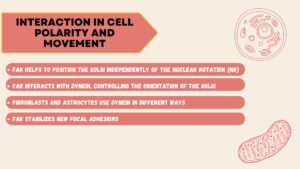
- FAK helps to position the Golgi independently of the rotation of the core (NR)
- Cells with FAK can orient Golgi without NR.
- In cells deficient in FAK (FAK-/−) or mutated cells (S732A−EGFP), this ability is significantly reduced.
- FAK interacts with dynein, controlling the orientation of the Golgi
- FAK binds to dynein and paxillin, helping to attach dynein to focal adhesions.
- This allows dynein to extend the microtubules, positioning the centrosome and the Golgi system.
- Phosphorylation by S732 is important for the functioning of FAK
- Mutation of this site (S732A) weakens the interaction of FAK with dynein.
- This disrupts Golgi positioning, but does not completely stop the binding of FAK-dynein, which means that other factors may be involved.
- Fibroblasts and astrocytes use dynein in different ways
- In fibroblasts, dynein pulls the centrosome forward.
- In astrocytes, dynein bends microtubules differently, which indicates differences in cell types.
- FAK stabilizes new focal adhesions
- These spikes serve as reference points for the dynein, helping to position the centrosome.
- This process is crucial for cell polarity and movement.
Sadia:
Pg 16-18:
- FAK (Focal Adhesion Kinase) helps cells move in the right direction by keeping dynein (a motor protein) attached to focal adhesions (sticky spots that help the cell grip surfaces).
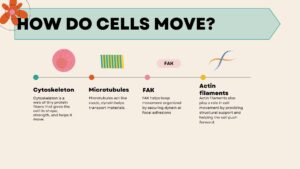
- Dynein pulls on tiny cell roads (microtubules) to position the centrosome (a control center that helps the cell move).
- Other forces also affect centrosome positioning, including:
- Dynein near the nucleus, which keeps the centrosome close.
- Dynein at the back of the cell pulls the centrosome backward.
- FAK helps balance these forces, keeping the centrosome at the front so the cell can move properly.
- FAK also helps cells sense pressure and movement, which is important for staying organized and responding to the environment.
- This is important in cancer research because cancer cells move in the wrong way and spread where they shouldn’t.
- Scientists tested how FAK and dynein stick together using a special experiment called immunoprecipitation (a way to check if two proteins are connected).
- When they changed FAK (Ser732A mutation) so it couldn’t hold dynein, the cell couldn’t properly position the centrosome and Golgi, making its movement unorganized.
- These results show that FAK is important for cell movement, and since FAK is a target in cancer treatments, understanding how it works could help stop cancer from spreading.



This entry is licensed under a Creative Commons Attribution-NonCommercial-ShareAlike 4.0 International license.

